
modified cdi and cr 80 coil

Circuit diagram
attachment.php


Here is the Board Layout from the parts side.

attachment.php


SCR,C106D,4A,400V,TO-202AB CASE
http://www.jameco.com/webapp/wcs/stores/servlet/ProductDisplay?freeText=C106D&langId=-1&storeId=10001&productId=160119&search_type=jamecoall&catalogId=10001&ddkey=http:StoreCatalogDrillDownView
It's stated in the modded jag clone diagram, that a 600v- 8a SCR is used but the c106d is rated 400v-4a, then your link to a part is the c106d1.

So which one is it?
A 600v-8a?
c106d?
c106d1?

Can I use this one instead?
5P4M 400v-5A
Compatable?
 
Hi, I've always used the C106D SCR. Rated at 400V, 4A. This is more than enough for this application. Like, I used 250VAC rated charge caps & havent had a failure in several thousand kilometers on mine, plus I've built several for friends who havent had a failure, so voltage wise its fine. Current wise its so over rated for this application it doesnt warrant consideration. This SCR is the one that was used in the origonal KDX CDI, so it has all the correct opperating specifications, is cheap & commonly available. Use the C106D. Cheers
 
Re: Waterproofing a mag?

It's stated in the modded jag clone diagram, that a 600v- 8a SCR is used but the c106d is rated 400v-4a, then your link to a part is the c106d1.

So which one is it?
A 600v-8a?
c106d?
c106d1?

Can I use this one instead?
5P4M 400v-5A
Compatable?

Any 400V (or more) SCR, if connected correctly & everything else being correct, will fire, but, as I have said b4, the Gate threshold characteristic will in all probability be different. This means that the CDI will fire at a different time. How different depends on how different that gate threshold characteristic is from that of the C106D's. The C106D is a very commonly used component, & they're cheap as chips. U'll get them over the counter at any electronics outlet. Cheers
 
Id like to thank you guys for doing this even though I will not be building my own. I would love to but it took me several hours to read this since most of it might as well been greek to me. That said from what I can understand I do like how you all have made a CDI set up that is more adjustable then anything else out there. Keep up the good work I look forword to see how you all do on more things like this in the future.
 
Cool, now u can enjoy smooter running & higher reving motor, with better torque. I recently got an email from a guy I had sent a rough schematic & the layout I use for the stock Jag CDI. He is going to try & get them both drawn up on the computer & post them, hopefully at the very beginning of a new thread so people dont have to seach to find them. If he gets this done I will post some tips telling how people can fine tune them to their specific needs by simply changing the value of a resitor or adding another tantalum cap in the timing network. Cheers
 
Cool, now u can enjoy smooter running & higher reving motor, with better torque. I recently got an email from a guy I had sent a rough schematic & the layout I use for the stock Jag CDI. He is going to try & get them both drawn up on the computer & post them, hopefully at the very beginning of a new thread so people dont have to seach to find them. If he gets this done I will post some tips telling how people can fine tune them to their specific needs by simply changing the value of a resitor or adding another tantalum cap in the timing network. Cheers

Gettin on it :)
just got busy with work/projects/work projects.
 
well, I haven't taken a photo of the bread board yet. this is my version of the CDI.

I have replaced the jumpers with single throw, double pole, 3 position switches. this was to take into account for jp4 and jp5.

I used an old 240V extension cord for the wiring. I striped the outer sheathing. Unsoldered the stock wires from the mag coil and rocker switch, so there was no potential voltage drops in the wires.


05052013424_zps0fec5556.jpg


Note: the SBP rocker switch has to be reversed in order to take into account the new version of the circuit diagram. the off position becomes the on position. as the switch doesnt earth the red in the circuit anymore.

The bike runs very well now. peak power for me is around the 3000 - 4000rpm mark. very low vibrations. I love being able motor around at low rpm and not making lots of noise.

I dont have to use much choke either. I only have to use it when starting on a cold morning and I need to turn it off almost straightaway

Thanks Ivan and Dracothered
 
Cool. They do make for a smoother running % torquier motor. Once we get a simple vero board layout up it should help more people who dont have electronic experiance to get 1 built. There isnt that much to them & they really do make a noticeable difference. Cheers
 
I .m noob here, please help me which ignition coil is the best for jaguar cdi ?, is it true this cdi can use with any ignition coil and it can work with all jumpers are taken out. Thanks
 
Hi, if u build the stock Jag circuit it will run no problem with no jumpers attached, however, if u build the 2 in 1 unit that is shown schematically earlier in this thread, u will need to have jumpers 4 & 5 attached at all times as these 2 r used to select between the stock Jag circuit or a variation on the international model of the KDX. To make a stock Jag circuit using the 2 in 1 schematic is relatively easy. See jumper 4 selects either a 16 ohm or 27 ohm resistor to earth. U need the 16 ohm for the Jag circuit. It connects to the cathode (or k) on the SCR & earth. Leave the 27 ohm out, & jumper 4 & pins. Also, see jumper 5 bridges either a 100 ohm or a 390 ohm resistor, thus taking the bridged resistor out of circuit. U need to remove the 100 ohm resistor & jumper 5 & pins. Thats it. As for the coil, I think the CR80 coil gives the hotest spark, but almost any small MX coil will work. Cheers
 
hi Ivan H, do you mean when I use Modified CDI Schema of dracothered member, should attach 4&5 jumpers. Is it right?, sorry for my English.
 
Hi, yes, that is correct, jumpers 4 & 5 must be attached at all times but be sure to properly understand their use to avoid advance/retard extremes. To select the stock Jag circuit u would place jumper 4 to select the 16 ohm resistor. Jumper 5 MUST then bridge (short) the 100 ohm resistor, thus taking it out of the circuit. Alternativly, to select the more advanced timing of the international variant of the KDX CDI, jumper 4 would be placed to select the 27 ohm resistor. Jumper 5 then MUST be placed to bridge (short) the 390 ohm resistor, thus taking it out of the circuit. Jumpers 1, 2 & 3 are left off the board when you start testing for best position. First test for low RPM setting of jumpers 1 & 2 by adding either jumper 1 or jumper 2 (not both, tho it wont hurt if u do) to find which gives best low RPM power. To test for jumper 3 is the same except you are looking for best high RPM performance. For a little more flexibility in high RPM adjustment, the 0.47uf capacitor that isnt on a jumper may also be put on a jumper to earth. Hope this all helps. Cheers
 
Last edited:
I used 3 switches to change between 0, 3, 6, 12 degrees of retards.
Once I accidentally switched from 3 to 0 degrees of retard while the the engine was running.
In theory my engine might have gone poof, but it didn't, and I could change back and forth between 0 and 3.
It was by accident at first, so I didn't want to try to switch between other degrees (6 and 12).

My favorite is 3 degrees retard.
Anybody care to share your favorite?
(I know different engine setting will variate the optimum timing retard, I am just curious about the majority timing)
 
Last edited:
Hi, since reaching a state of tune that I will leave it at (no more modifications) I have fine tuned the CDI to suit the motor's requirements & then done away with jumpers, soldering all components in place. I dont use the 2 in 1 variation, rather I used the stock Jag values of a 16 ohm pulldown resistor & a 390 ohm in serirs with the 1k as a starting point & went from there, using a few non stock values to achieve the best low & high RPM performance. These CDI's are really quite simple & easilly modified to suit ur motors needs. If anyone wants more info on how to go about doing this, just yell out & I will post a few pointers. Cheers
 
Hi, since reaching a state of tune that I will leave it at (no more modifications) I have fine tuned the CDI to suit the motor's requirements & then done away with jumpers, soldering all components in place. I dont use the 2 in 1 variation, rather I used the stock Jag values of a 16 ohm pulldown resistor & a 390 ohm in serirs with the 1k as a starting point & went from there, using a few non stock values to achieve the best low & high RPM performance. These CDI's are really quite simple & easilly modified to suit ur motors needs. If anyone wants more info on how to go about doing this, just yell out & I will post a few pointers. Cheers

I'm wondering if this will work on a Honda clone CRF 50 four stroker?
 
Hi Dracothered, I'm not familiar with that bikes ignition, but if it only has 2 wires coming from the magneto's stator coil it would most likely fire up. The problem is that a 4 stroke has a different timing curve requirement than a 2 stroke. A 4 stroke needs the timing to advance up to a certain point dependent on rpm, whereas a 2 stroke needs the timing to advance up to approximately 2/3 max rpm, then to start retarding the timing, which is what the tantalum caps in these CDI's control. Cheers
 
Hi Dracothered, I'm not familiar with that bikes ignition, but if it only has 2 wires coming from the magneto's stator coil it would most likely fire up. The problem is that a 4 stroke has a different timing curve requirement than a 2 stroke. A 4 stroke needs the timing to advance up to a certain point dependent on rpm, whereas a 2 stroke needs the timing to advance up to approximately 2/3 max rpm, then to start retarding the timing, which is what the tantalum caps in these CDI's control. Cheers

After posting my question I thought about it some and came to the answer of no this CDI would not work and for one reason it use a sensor set up on the Honda engine. Also they make many CDI's for the Honda (clone) engines that are good.
 
Hi Dracothered, I just remembered I have a schematic somewhere for a CDI for a (4 stfoke) Honda 90, like the Posty's use here in Oz. I'm not sure off the top of my head if its a 2 or 3 wire type but I'll dig it out & have a look for u. Also here in Oz, Jaycar, a supplier of electronic components & kits, has a kit of a good quality triggered CDI. Many of these type kits are supplied by different vendors around the globe so u may find somewhere like Radio Shack. I'm not sure if I have a schematic for it or not but I'll have a look & get back to u on it. The timing on the triggered type CDI's are usually controlled mechanically & not by an electronic timing network in the CDI so it should be easier to adapt 1. The triggered type are by far the more common type also. Cheers
 
Hi Dracothered, I just remembered I have a schematic somewhere for a CDI for a (4 stfoke) Honda 90, like the Posty's use here in Oz. I'm not sure off the top of my head if its a 2 or 3 wire type but I'll dig it out & have a look for u. Also here in Oz, Jaycar, a supplier of electronic components & kits, has a kit of a good quality triggered CDI. Many of these type kits are supplied by different vendors around the globe so u may find somewhere like Radio Shack. I'm not sure if I have a schematic for it or not but I'll have a look & get back to u on it. The timing on the triggered type CDI's are usually controlled mechanically & not by an electronic timing network in the CDI so it should be easier to adapt 1. The triggered type are by far the more common type also. Cheers

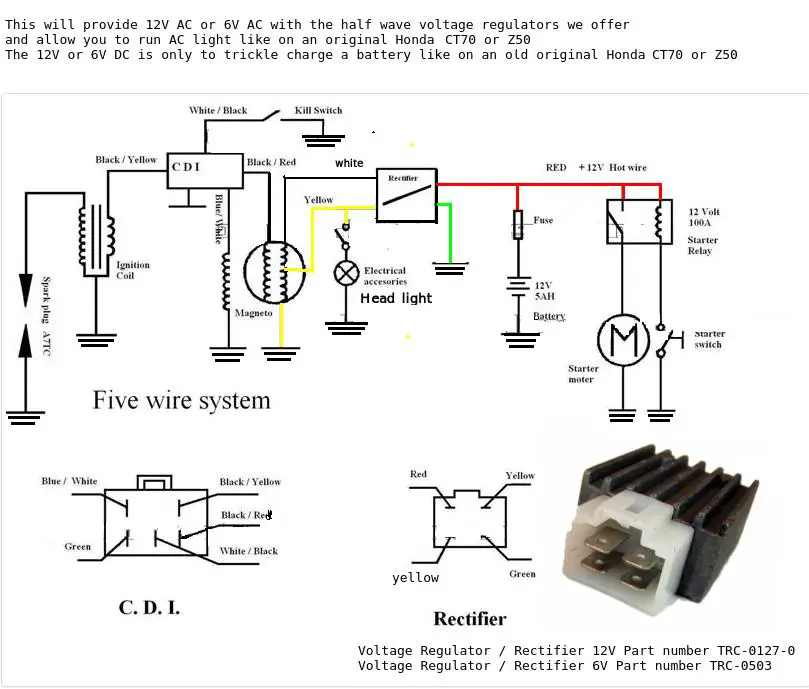
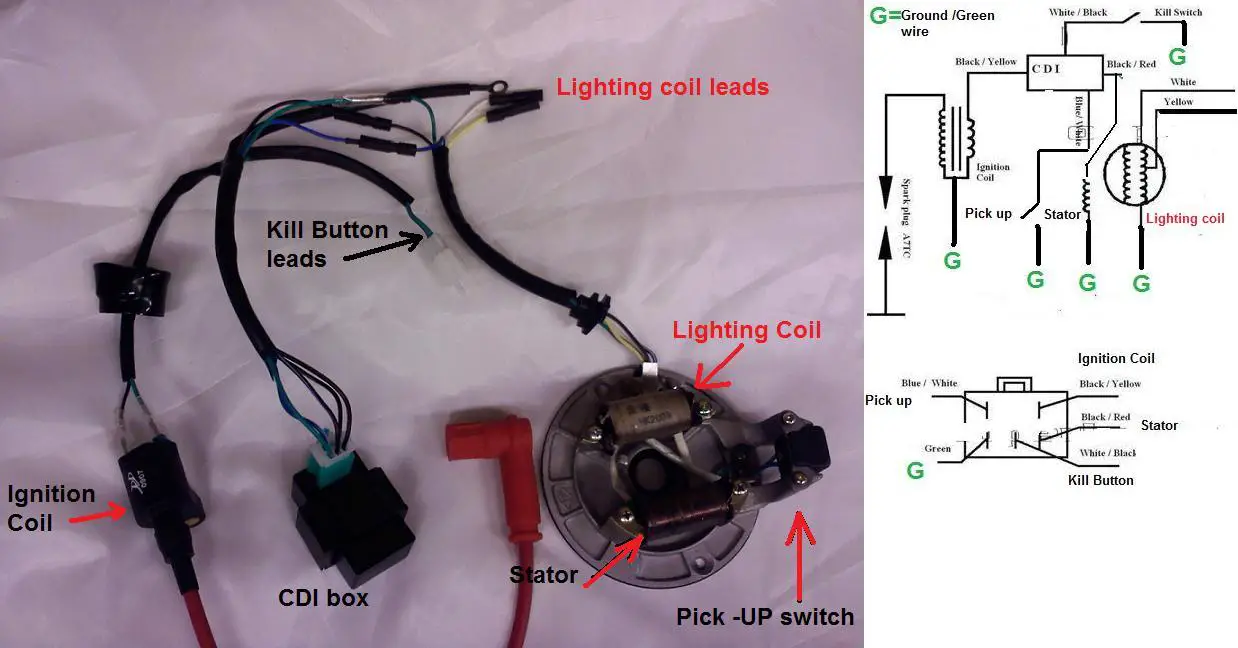
Hey ivan this is what the ignition setup looks like on my new engine Honda CRF50 clone.

5_wire_Lifan_Wiring_041605_HI.jpg


CombinedSimpleWiring.jpg
 
Back
Top